
A farmer can work on the same plot of land for more than twenty years and still barely break even.
Sound familiar? I’m sure it does.
Across Africa, that’s the everyday reality for millions of smallholder farmers — they grow enough to survive but rarely enough to build wealth.
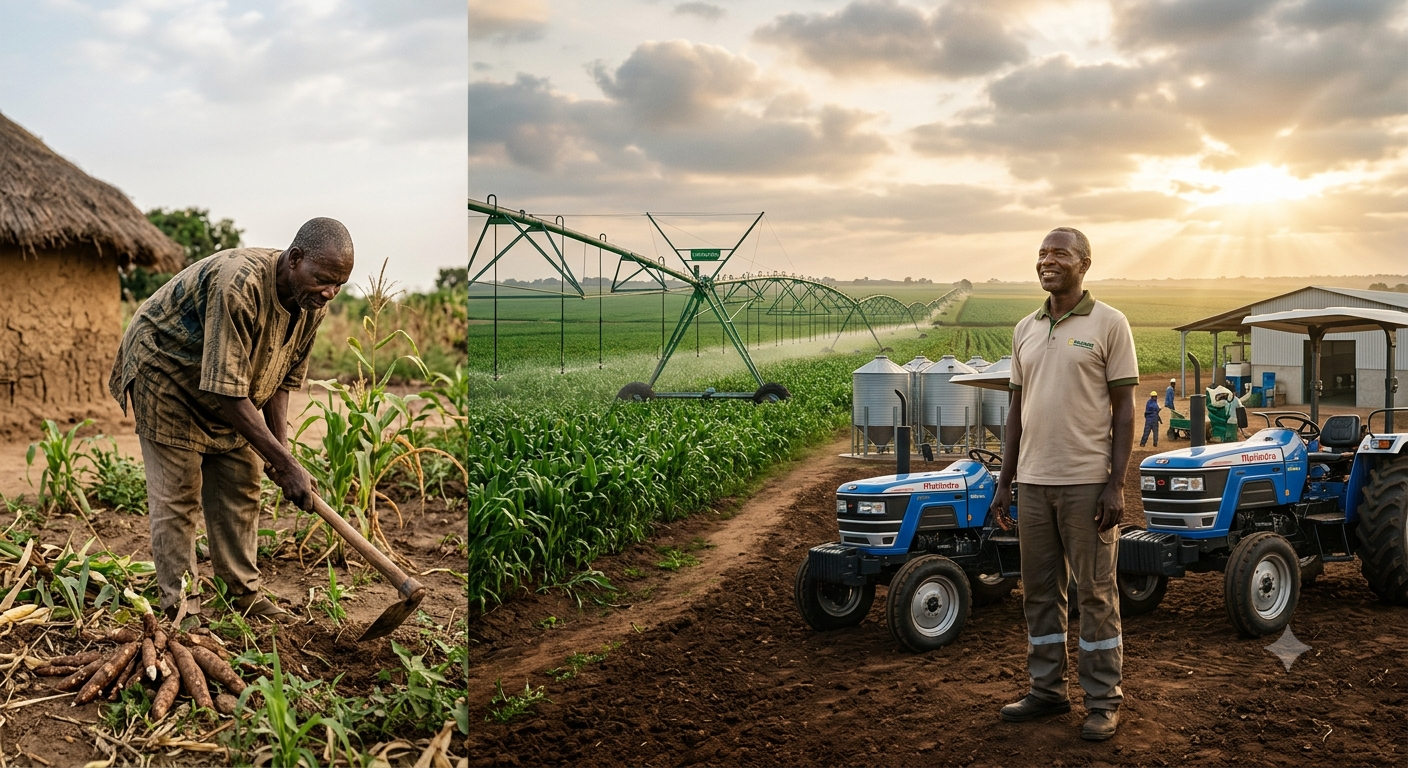
Smallholder farmer commercialization in Africa is the shift that changes this story. It’s the move from farming to feed a household to farming as a real business.
Before we delve deeper, let’s understand what smallholder farmer commercialization really means.
What is smallholder farmer commercialization?
Commercialization simply means producing with the market in mind, and not just the next meal for personal consumption.
It’s a mindset shift as much as a business one.
A peasant farmer grows what the family needs, but a commercial farmer grows what buyers want, in volumes that generate consistent income.
That single shift changes everything downstream, from what crops get planted to how a farmer plans the season ahead.
Moving from Farmer to Agri-Entrepreneur
A new kind of farmer is emerging across Africa, one who thinks less like a laborer and more like a business owner.
Call it the African agri-entrepreneur.
This kind farmer tracks input costs, negotiates prices, and reinvests the proceeds (profits) back into the next planting cycle.
They treat their farm as a business asset, not just a source of food.
A farmer who sees themselves as an entrepreneur makes different decisions at every stage, from what to plant to whom to sell it.
This new face of African agriculture is becoming harder to ignore as younger farmers, in particular, are entering the sector with business training, digital tools, and a clear profit mindset already in place.
Why Most Farmers Stay Stuck
Lack of effort does not keep farmers small — it’s the lack of the following systems around them:
1. Limited market access
Many farmers simply have nowhere reliable to sell a bulk of their produce, and without buyers, there’s little to no motivation to grow beyond household needs.
Poor roads, few buyers, and unpredictable pricing all discourage most farmers from scaling their production.
2. Weak agro-finance options
Growing for the market requires upfront capital for seedlings, tools, and labour, but access to agro-finance remains out of reach for most smallholders.
Traditional lenders often view smallholder farming as too risky, leaving farmers to finance expansion (if possible) out of their own pockets.
How African Smallholder Farmers Can Access Global Markets in 5 Practical Steps
Reaching international buyers can feel out of reach for a small farm. In practice, it comes down to these five clear moves:
- Meet quality and certification standards: Global buyers expect consistent grading, proper drying or processing, and, in many cases, formal certification before they commit to a purchase.
- Aggregate produce through a cooperative or buying group: Export buyers rarely deal with small farms individually. Pooled volume through a cooperative makes a farmer’s produce commercially viable at scale.
- Build traceability into the supply chain: Buyers increasingly want to know exactly where produce came from. Simple record-keeping on planting, harvesting, and handling builds that trust.
- Connect with export-ready off-takers: Structured buyer agreements, often brokered through agribusiness partners or cooperatives, remove the guesswork of finding a market.
- Invest in post-harvest handling: Poor storage or transport can undo months of good farming in days. Proper drying, packaging, and cold-chain handling protect both quality and price.
Farmers who work through these steps, usually alongside a cooperative or agribusiness partner, stand a realistic chance of reaching buyers well beyond their local market.
Cooperative Farming Advantage
Cooperative farming solves problems no single smallholder can solve alone.
Pooled produce means better prices, and pooled resources mean shared equipment and shared risk.
A cooperative society gives farmers powerful leverage as buyers take a group of 100 committed farmers far more seriously than a single individual with a small harvest.
Beyond pricing power, cooperatives often unlock access that individual farmers simply can’t get on their own.
Cooperatives also tend to qualify more easily for agro-finance and support programmes, since lenders and policymakers view group structures as lower-risk and easier to monitor than scattered individual farms.
In a nutshell, cooperative farmers have access to the following advantages:
- Stronger bargaining power on pricing
- Shared access to storage and transport
- Group eligibility for agri-finance
- Collective knowledge-sharing on best practices
- Easier access to export buyers and certification schemes
Farmers who joined Feed Africa cooperatives consistently report better market access and steadier income than those farming in isolation.
How Farmers Can Access Agro-Finance in Africa
Money remains the biggest barrier between a peasant farmer and a commercial one, but we have some good news for you.
At Feed Africa, agro-finance options are expanding, which is how we help most smallholder farmers scale.
Microfinance institutions now offer smaller, farmer-friendly loans suited to seasonal planting cycles, rather than the rigid terms of traditional bank lending.
Cooperative-backed lending is also growing, where group guarantees replace the collateral that an individual farmer often can’t provide.
Government-backed agricultural loan schemes are another route, typically offering lower interest rates in exchange for growing designated priority crops.
Private impact investors and agribusiness partners increasingly offer structured finance, tying funding directly to specific value chains such as cocoa, palm, or ginger.
Mobile-based agri-lending platforms are also reshaping access.
Farmers can now apply for and receive small loans by phone, with repayment tied to harvest timing rather than to fixed monthly schedules.
Farmers store produce in a certified warehouse and borrow against its value, unlocking cash flow without needing to sell immediately at potentially lower post-harvest prices.
Building a Value Chain
Commercialization works best when it’s anchored around a strong value chain, not just a crop. Cocoa, palm, and ginger each offer that kind of structure for smallholder farmers in Africa.
Cocoa already connects to established export markets, giving commercializing farmers a clear demand path.
The opportunity lies in capturing more value locally, through better post-harvest handling and organized bulk selling.
Palm offers steady, year-round demand across food and household product industries, making it a dependable anchor for farmers building consistent income.
Ginger, with its lower land requirements and rising global demand, gives smaller farmers a realistic entry point into commercial-scale agribusiness.
Together, these three crops offer a practical, achievable path from subsistence plots to structured agribusiness.
How Smallholder Farmers Can Move from Subsistence to Commercial Farming
Commercialization doesn’t require starting over. It requires a clear, sequenced plan.
1. Start with one strong value chain
Trying to commercialize every crop at once spreads resources too thin. Choosing one strong value chain, cocoa, palm, or ginger, gives a farmer a focused, manageable starting point.
2. Access structured agri-finance
Farm income grows fastest when farmers can invest ahead of the season, not just react to it. Structured agri-finance, tailored to planting and harvest cycles, removes much of that guesswork.
3. Join or form a cooperative
There’s real strength in shared infrastructure and shared bargaining power. A cooperative turns individual farmers into a collective business voice.
The Role of Government and Private Investment
Smallholder commercialization rarely succeeds on farmer effort alone. It needs backing.
Government support, through infrastructure, extension services, and land policy, sets the foundation.
Private investment then builds on that foundation, funding processing facilities, structured buyer agreements, and reliable agri-finance products.
Africa’s largest smallholder farmer commercialization and empowerment initiatives tend to combine both.
Public policy creates the enabling environment, while private capital delivers the working systems that farmers actually use day-to-day.
What Commercialization Means for Farm Income
The end goal of all this is higher, steadier farm income. Not just a single good season, but a repeatable, scalable business model.
Farmers who commercialize typically see income grow from multiple directions:
Better prices through cooperatives, reduced post-harvest losses through access to storage, and new revenue through value-added processing.
That’s the real difference between a subsistence plot and an agribusiness. One survives the season.
The other builds towards the next one and the one after that.
Africa’s smallholder farmers already have the land, the knowledge, and the will. What’s needed now is the structure, cooperatives, finance, and value chains to turn that potential into lasting income.